
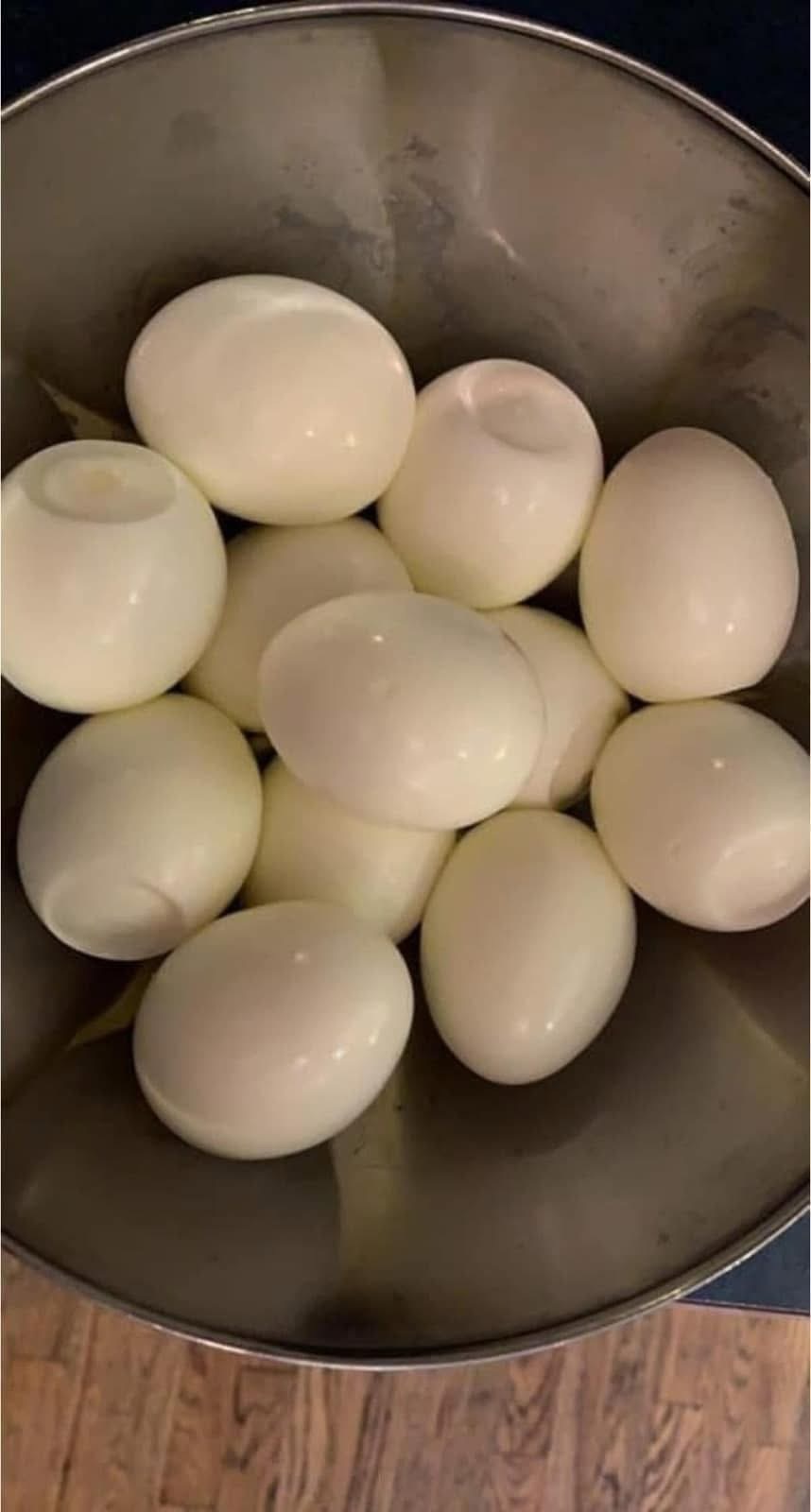
You boil the eggs.
You cool them.
You start peeling…
And then — disaster.
Instead of a smooth, clean peel, you’re left with ragged whites , half the egg still trapped in the shell , and a kitchen counter covered in egg fragments.
Sound familiar?
You’re not alone.
Even experienced cooks struggle with hard-boiled eggs that won’t peel cleanly .
But here’s the good news:
There’s a chef-approved hack that guarantees smooth, easy peeling — every single time.
And it’s not about age, vinegar, or baking soda.
It’s about temperature, technique, and timing .
Let’s dive into the pro secret that transforms your hard-boiled eggs from frustrating to flawless .
🔥 The #1 Reason Eggs Are Hard to Peel
Fresh eggs are the worst for peeling.
Why?
When eggs are very fresh , the albumen (egg white) has a lower pH , making it more acidic and stickier to the inner membrane.
As eggs age, they naturally lose CO₂ , the pH rises, and the membrane separates more easily from the white.
✅ Best eggs for peeling: 7–10 days old
❌ Worst eggs for peeling: Laid yesterday
But what if you only have fresh eggs?
Don’t worry — the chef’s hack works even then.
🍳 Chef’s Clever Hack: The Ice Bath + Rolling Method
This method combines science and technique to make peeling effortless.
✅ What You’ll Need:
- Hard-boiled eggs (cooled)
- A bowl of ice water
- A flat surface (like a countertop)
🥣 Step-by-Step: The Perfect Peel
1. Boil Eggs the Right Way
- Place eggs in a single layer in a saucepan.
- Cover with cold water (1 inch above eggs).
- Bring to a gentle boil , then cover and remove from heat .
- Let sit for 9–12 minutes (depending on size).
- Drain and immediately transfer to an ice bath .
2. Cool Completely (Key Step!)
- Let eggs sit in ice water for at least 10–15 minutes .
- The cold shock contracts the egg inside , creating a gap between the white and the shell.
3. Roll to Crack
- Take one egg and gently roll it on the counter using the palm of your hand.
- Apply light pressure — just enough to crack the shell all over without smashing the egg.
4. Peel Under Water
- Hold the egg under running cold water or in a bowl of water.
- Start peeling from the wider end (where the air pocket is).
- Let the water get under the shell — it helps lift the membrane away cleanly.
✅ Result: Smooth, perfect whites — every time.
🧠 Why This Works
This is the same method used in professional kitchens and catering operations — where hundreds of eggs are peeled daily .
🔁 Bonus Tips for Foolproof Results
✅ Use older eggs — 7–10 days old peel best
✅ Add a pinch of salt or baking soda to the water — can help loosen the membrane (optional)
✅ Tap before rolling — lightly tap the egg on the counter first to start cracks
✅ Peel in batches — keep unpeeled eggs in the ice bath until ready
✅ Store peeled eggs in water — in the fridge for up to 5 days (change water daily)
❌ What Doesn’t Work (Despite the Hype)
🚫 Only using vinegar — doesn’t help peeling (great for pickling, though)
🚫 Shaking in a jar — can work, but often smashes the egg
🚫 Peeling warm eggs — always cool them first!
Final Thoughts
You don’t need magic — you need method .
With this chef’s clever hack , you’ll never struggle with sticky, torn hard-boiled eggs again.
Just remember:
👉 Cool completely
👉 Roll gently
👉 Peel under water
And enjoy perfectly peeled eggs — ideal for:
- Deviled eggs
- Egg salad
- Snacking
- Meal prep
Because sometimes, the best kitchen hacks are the ones that turn frustration into flawless results .